-1.svg)
TL;DR

Window treatments do a lot for a room — they control light, shape how the space feels, and tie the whole look together. Yet they're one of the hardest categories to sell online.
Unlike a sofa or a table, fabric never holds one fixed shape — it moves, drapes, and shifts with the light. Static photos and swatches force customers to imagine texture, fullness, and how sheer or heavy a fabric really is. That imagination gap leads to hesitation, abandoned carts, and costly returns.
3D curtain visualization closes this gap.
With real‑time rendering and advanced textile simulation, it turns curtain shopping into a confident, interactive process. Customers can explore every possible variation, zoom in on the weave, adjust dimensions, switch fabrics instantly, сombine different curtain types. And most importantly, they can see the curtains inside their own room before anything is cut.
This guide explains why curtain visualization is uniquely complex and how modern 3D technologies are reshaping product presentation in textile e-commerce.
Why Curtains Are One of the Most Challenging Products to Sell Online
Window treatments are far more complex than standard e-commerce goods, with many variables shaping the final result.
-
Fabric behavior: The visual weight, texture weave (e.g., linen slubs vs. velvet piles), glossiness, and fiber density.
-
Transparency: How the fabric filters and diffuses light, from sheer voiles to full blackout materials.
-
Drape: How the fabric behaves under gravity, from structured folds to soft, flowing silhouettes.
-
Fullness ratio: The same fabric can look dramatically different depending on how much material is gathered across the window width.
-
Pleat style: The header execution (pinch pleats, grommets, rod pockets, wave folds) fundamentally changes how the fabric behaves across the entire panel.
-
Pattern behavior: Printed designs can stretch and compress depending on pleats and folds.
-
Mounting position: Ceiling mounts, wall mounts, inside mounts, and outside mounts drastically alter the spatial volume of the product.
-
Window size: Curtains that look balanced on one window may appear oversized or undersized on another.
-
Room lighting: Fabrics change color entirely depending on natural morning light, ambient midday sun, or warm evening indoor bulbs.

Why Customers Hesitate Before Buying Curtains
Without a reliable way to visualize the final result, shoppers worry about choosing the wrong fabric, selecting an unsuitable color, ordering incorrect dimensions, or creating a design that clashes with the rest of the room.
As a result, many postpone their decision, leave the site to seek inspiration elsewhere, request physical samples, or abandon the purchase entirely. Even when they do complete the order, uncertainty often leads to post-purchase regret and product returns, as the final result may differ from expectations formed online.
Why Returns Are So Costly
Unlike mass-produced products, made-to-measure curtains are often manufactured specifically for a single order and cannot easily be restocked or resold. When a customer's expectations do not match the final installation, the financial impact can be significant for both the buyer and the retailer.
The Limitations of Traditional Photography in Curtain E-Commerce
For decades, commercial photography was the foundation of curtain and textile merchandising. It remains an essential part of the customer journey, but it was never designed to support the level of customization, personalization, and scale that modern textile e-commerce demands.
High Content Production Costs
According to industry sources such as StyleShoots, Pixelz, and Peerspace, creating a single interior roomset for a photoshoot can cost anywhere from $3,000 to over $10,000, including studio rental, set construction, furniture and décor, crew, and post‑production.
For larger collections, total costs easily reach tens of thousands of dollars, and every new fabric, size, or configuration requires additional preparation and a separate shoot.
Limited Scalability
If you offer 50 fabrics, 5 heading styles, 3 hardware finishes, and multiple width and length options, the number of possible combinations quickly reaches into the thousands.
As a result, brands typically photograph only a small percentage of their inventory and rely on swatches or descriptions for the rest.
Lack of Personalization
A photograph is static. It cannot adapt to a customer's window dimensions, room lighting, preferred fullness, or curtain position. It shows only one version of a product, while every customer requires a different one.
Fabrics behave differently under varying lighting conditions — natural daylight, evening warm light, or artificial indoor lighting can significantly change how color, texture, and transparency are perceived. Photography captures only a single lighting scenario, which often fails to reflect real-world variability.
What Is 3D Curtain Visualization?
3D curtain visualization is a technology that transforms physical fabrics and window‑treatment designs into accurate, interactive digital models that customers can explore before purchasing.
Using 3D models, textures, and real-time rendering, it recreates how curtains look and behave across different materials, dimensions, and room settings with proportionally accurate scale, lighting, and material behavior.
In practice, the technology creates a digital twin of a retailer's curtain catalog that customers can interact with online.
How it works:
- 3D models represent the geometry of curtain styles, headings, and hardware.
- PBR materials define realistic fabric appearance, including texture, color, gloss, and weave. A single material consists of multiple PBR maps, each responsible for specific surface properties.
- Physics-based draping simulates how fabric behaves under gravity, including folds, tension, and natural hanging structure, ensuring realistic motion and silhouette.
- Real-time rendering updates the visualization instantly as customers change fabrics, dimensions, or configurations.
Key Features of Modern 3D Curtain Visualizers
Product Visualization
- 360-degree viewing & zoom: Customers can rotate products and zoom in to inspect fabric texture, weave structure, stitching, and transparency from any angle.
- Real-time configuration: Users can switch fabrics, colors, dimensions, and curtain styles while seeing changes reflected immediately.
- Augmented Reality (AR): Web-based AR allows shoppers to place configured curtains in their physical space using a smartphone or tablet.
Room Visualization
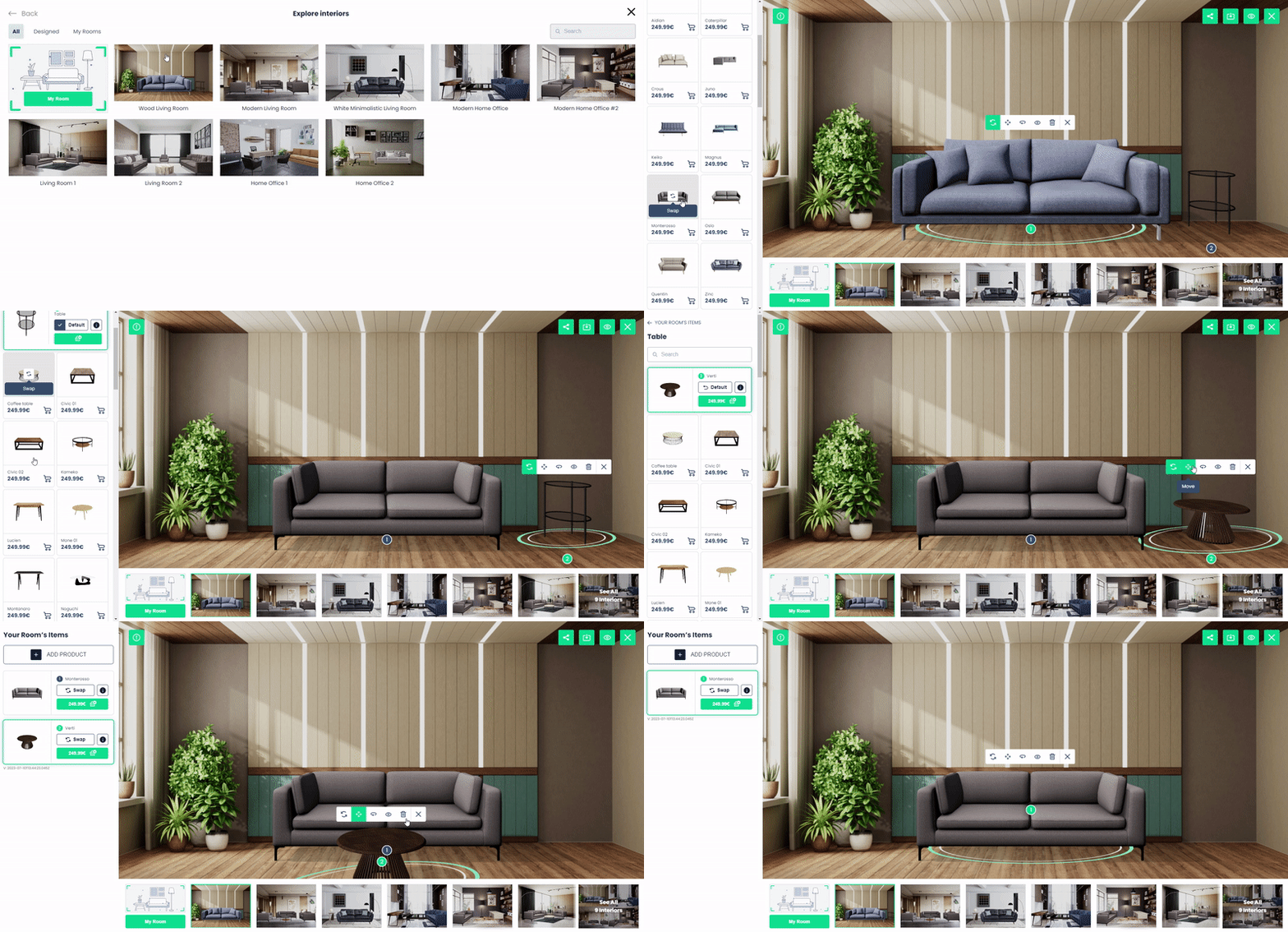
- Virtual showrooms: Preset digital interiors where customers can place curtains, explore collections, compare styles, and discover complementary products in realistic environments.
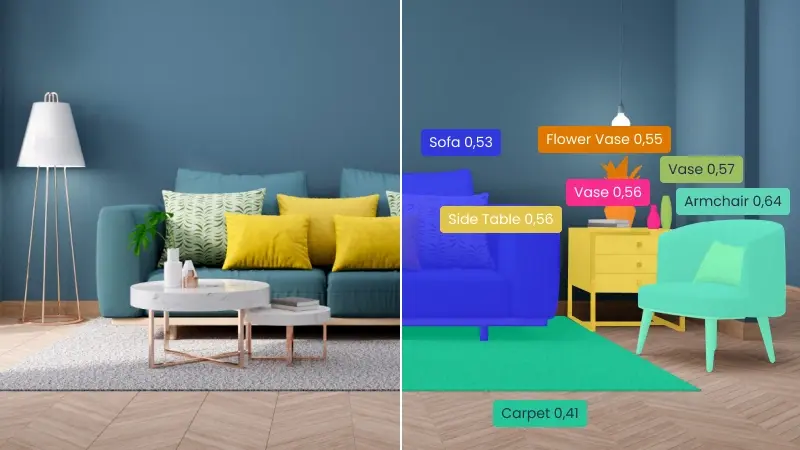
- User interior visualization: Customers can upload a photo of their room and preview curtains directly within their own space using AI-powered room reconstruction and product placement.
- Multi-layer curtain visualization: Users can combine multiple curtain layers, such as sheers and blackout drapes, within a single iteration.
Commerce Integration
- Real-time pricing: Pricing updates automatically as users change fabrics, dimensions, and configuration options.
- Cart synchronization: Selected configurations can be transferred directly to the shopping cart, keeping product specifications and pricing aligned throughout the purchase journey.
- Omnichannel usage: The same tools can be used across in-store showrooms, where consultants use tablets to configure products together with customers in real time.
Generative AI Images vs. AI-Powered 3D Visualization
Generative AI tools and simple photo‑based try‑on apps have become popular because they can produce interior concepts in seconds. They are effective for inspiration and early‑stage ideation, but they are not designed for product‑accurate e‑commerce.
The Limitations of Generative AI
- Inaccurate dimensions: Generated scenes look realistic but are not based on real measurements.
- Hallucinated products: AI may create fabrics, patterns, and configurations that do not exist in the retailer’s actual catalog.
- Unrealistic material behavior: Folds, pleats, transparency, and light interaction often do not reflect real textile properties.
- Inconsistent outputs: Each generation can produce a different room, breaking continuity in the shopping experience.
- No connection to commerce systems: Outputs are not linked to SKUs, pricing, inventory, or checkout.
- High manual effort, no platform structure: AI tools produce isolated images. Teams still need to manually organize assets, recreate variations, and rebuild content for every use case.
Where AI‑Powered 3D Visualization Excels
In contrast, AI‑powered 3D visualization platforms like Zolak combine computer vision, spatial analysis, and accurate 3D rendering to build a retail-ready shopping experience built around real products.
- Room geometry mapping: AI reconstructs spatial boundaries such as walls, windows, floor, and ceiling from a reference image.
- Accurate scale and placement: Curtains are positioned exactly as they would appear in a real installation.
- Real SKUs and product catalog: Every visual element is linked to actual products, rules, and variants.
- Physics-based material behavior: Fabric weight, folds, drape, and light interaction are simulated realistically.
- E-commerce integration: Pricing, inventory, and cart data stay synchronized with interactive modules.
- Complete variation coverage: Unlike generative AI, 3D visualization helps represent every fabric, size, heading style, and configuration, no matter how many combinations exist.
- Full‑interior visualization: Curtains can be visualized alongside other products (pillows, bedding, furniture), enabling complete‑look interior planning and higher AOV.
💡 In short: Generative AI helps customers explore ideas. AI-powered 3D visualization helps them confidently purchase real, manufacturable products.
Side-by-Side Comparison
| Feature | Generative AI | AI-Powered 3D Visualization (e.g. Zolak) |
| Technology core | Generative image creation and 2D overlays | Vision AI, spatial analysis, real‑time 3D rendering |
| Primary use case | Inspiration and mood boarding | Product visualization, configuration, high‑intent e‑commerce |
| Dimensional accuracy | Estimated, non-measured | Physically accurate scaling |
| Product representation | Fictional or approximate | Exact SKUs from catalog |
| Fabric behavior | Visually inferred | Physics-based simulation |
| Output consistency | Varies per generation | Stable and predictable across SKUs |
| Business integration | None | Connected to commerce systems |
Benefits of 3D Curtain Visualization for Customers
Custom curtains are a significant investment, and buyers naturally hesitate. Moving from flat photos to interactive 3D removes uncertainty and makes the entire shopping journey easier and more intuitive.
- Greater purchase confidence: Customers immediately see how curtains will look next to their walls, furniture, and real lighting.
- Faster decisions: Instead of waiting for physical samples, shoppers can test dozens of options instantly.
- Easier product comparison: Users can directly compare fabrics, colors, heading styles, and curtain setups to find the best match for their space.
- Seamless mobile shopping: Smartphones and tablets become interactive design tools for exploring products.
- Reduced custom-order anxiety: Visualizing dimensions, drape, and overall appearance before purchase helps customers feel more comfortable ordering made-to-measure products.
 Please note:
While 3D visualization platforms deliver highly realistic product representations and proportional scaling, they operate as powerful visual tools rather than precision on-site measurement hardware. They give customers the visual confidence to choose layouts and colors, but final made-to-measure orders should always be verified using actual architectural measurements to ensure manufacturing accuracy.
Benefits for Curtain Retailers and Textile Brands
For retailers and manufacturers, adopting AI‑powered 3D curtain visualization has a direct impact on revenue, margins, and operational efficiency.
- Higher conversion rates: Industry studies on 3D/AR commerce show conversion uplifts of up to 40% in certain product categories.
- Fewer returns: Improved visual accuracy reduces expectation gaps between online preview and real product, with studies in configurable and visual-heavy categories showing return reductions of up to ~20–40%.
- Lower content production costs: Replacing repeated studio photography with reusable 3D assets can significantly reduce visualization costs, with brands reporting substantial savings in the range of 40–70% depending on catalog complexity.
- Higher AOV: Multi‑layer setups, premium fabrics, and hardware upgrades become easier to understand and purchase.
- More effective sales consultations: Teams can visually validate recommendations, accelerating decision‑making.
- Faster product launches: New collections can be introduced digitally without waiting for studio production.
- A scalable digital asset ecosystem: The same 3D assets power configurators, room visualization, and marketing imagery.
How Zolak Powers 3D Curtain Visualization
Zolak is an AI-powered 3D visualization platform built specifically for home furnishings. It transforms static curtain catalogs into interactive, product-accurate digital experiences that customers can configure, preview, and purchase with confidence.
Instead of separate tools, Zolak connects product data, 3D visualization, and commerce workflows into one unified ecosystem.
Our approach is built around a single digital source — a digital twin (2D or 3D model). From this foundation, brands can generate a wide range of content with full control over cost, quality, and speed. Depending on the category, teams can choose between AI‑generated content or server‑side rendering directly from 3D models.
On top of this, this same foundation powers fully immersive experiences: configurators, viewers, and room visualization tools.
Building and Managing a Digital Curtain Catalog
- Step 1: 3D modeling: 3D models are created from detailed product photos and specifications.
- Step 2: 3D texturing: Real fabric properties like texture, weave, color, and light behavior are translated into reusable digital materials.
- Step 3: Catalog Setup inside Zolak CMS: Each 3D asset is uploaded into a user‑friendly dashboard and configured into products with their variations, rules, and pricing.
After digitization and catalog setup inside the client’s CMS account, these assets become the foundation for both content production and interactive experiencesю
Zolak Studio: Reducing Content Production Costs
On the content side, Zolak Studio enables brands to generate marketing visuals directly from the same 3D product assets.
- Silo images: Clean, isolated product shots optimized for standard e-commerce grid listings and catalog navigation.
- Lifestyle images: Hyper-realistic, fully staged interior renders tailored for social media, marketing banners, and targeted email campaigns.
AI Generated Content (Without 3D Assets)
Even if you don’t have 3D models yet, you can generate silo, lifestyle images, and product descriptions by uploading standard photos of your curtains into Zolak AI Product Content tool.

A Modular Approach: Which Components Can You Launch on Your Site?
The same digital foundation that powers content generation also enables interactive shopping experiences across the entire customer journey. You can select and integrate the exact interactive modules that match your business goals.
1. 3D Curtain Configurator with Built-in AR
This module embeds directly into existing product detail pages (PDPs) inline or as a pop-up. Shoppers can explore products in 360 and full 3D, zoom on details, swap fabrics, and resize curtains using responsive sliders.
- Built-in AR functionality: Mobile users do not need to download external apps or software. The feature works natively: a single tap launches the smartphone camera, allowing buyers to place the configured curtains on their windows.
2. Virtual Showroom (Pre-Set Interiors)
For customers looking for immediate inspiration, this module offers access to a curated library of pre-designed, professionally styled, or empty room templates that reflect popular design aesthetics, such as Scandinavian, Loft, or Classic.
- Instant visual inspiration: Users who don’t have a high-quality photo of their own space can instantly test configurations in beautiful, pre-rendered environments.
- Cross-selling engine: The showroom naturally drives product bundling by enabling users to combine complementary items, such as curtains, decorative pillows, and bedspreads, within a single visual experience, encouraging more complete interior purchases and increasing AOV.
- Flexible marketing tool: Your marketing team can manage and update these interiors through the CMS. This allows them to generate ready-to-use visuals for promotional campaigns, highlight seasonal trends, or showcase best-sellers without the need for physical photoshoots.
3. Virtual Showroom Add-on: User Interior Visualization
This advanced module transforms the shopping experience from browsing products to designing directly inside the customer’s own room.
- One-click photo upload: From the product page, users open the experience and instantly upload a photo of their interior.
- Smart space mapping: Zolak’s AI analyzes the photo, reconstructs the digital room layout for accurate product placement.
- Object removal: Shoppers can hide all detected objects in their photo, or choose to hide individual items to create a clean canvas for their new design.
- Realistic product visualization: Customers select curtains or sheers from the retailer’s catalog and place them onto the window with realistic lighting, shadows, and proportions.
- Multi-layer textile placement: Users can combine multiple curtain layers in a single scene, such as a lightweight sheer base (tulle) with a heavier blackout curtain, to visualize realistic multi-track window setups.
- Adjustable dimensions: Customers can change curtain width and height to match their actual window, and the visualization updates instantly.
Real-World Example: How Textile Brands Use 3D Visualization in Practice
Valolma, a Finnish brand specializing in made-to-measure curtains, has integrated Zolak User Interior Visualization with Built-In Configurator directly into its product pages.
Instead of relying on static product images, customers can try on and configure curtains in a real interior context before purchase. The selected configuration is then passed directly into the shopping cart.
As Emilia Peltola, Owner of Valolma, notes:
“We worked with Zolak on the development of software and 3D models for curtains and our experience has been outstanding. Zolak brings clarity to complex requirements and provides a flexible, tailored approach that makes even complex projects feel structured and manageable.”
Conclusion: Transform Your Textile E-Commerce Experience
The core problem in the curtain and textile market is that customers can’t confidently imagine how a product will look in their homes, while retailers struggle to present every style and variant at scale.
Zolak brings clarity, accuracy, and scalability to a category long held back by guesswork and costly manual processes. By unifying product-accurate visualization, room-level realism, and automated content production into a single platform, Zolak delivers a measurable business impact:
- Higher conversion through true‑to‑life visualization
- Lower returns thanks to accurate scale, color, and material behavior
- Higher AOV via effortless multi‑layer and bundle visualization
- Faster content production with automated silo and lifestyle imagery
- Scalable catalog management through a unified CMS and reusable digital assets
- Competitive advantage by offering a level of personalization competitors cannot match
Take the Next Step with Zolak
If you want to modernize how you present window‑treatment products and help customers feel confident choosing custom curtains, it’s time to explore what Zolak can do for your brand.
Book a personalized demo today!