
-1.svg)
In the race to move e-commerce beyond static product grids and into interactive experiences, two platforms often come up: Threekit and Zolak.
At first glance, they may look similar. Both offer 3D configurators, augmented reality (AR), and virtual photography. But in practice, they are built to solve different business problems and support different buying journeys.
Threekit is an enterprise-grade visual commerce engine built for complex B2B catalogs, manufacturing rules, and long sales cycles.
Zolak is an AI-powered 3D visualization platform built to remove the visual barrier to purchase and drive e-commerce conversions.
Beyond configuration, Zolak lets buyers place products in realistic settings, combine multiple items in the same scene, and see how everything works together. It focuses on immersion, visual clarity, and ease of use.
This guide breaks down the key differences between Threekit and Zolak, so you can choose the platform that best aligns with your business goals, sales model, and growth strategy.
Threekit: The Enterprise Sales Engine
Threekit is a powerful visual commerce platform built with enterprise complexity in mind. With roots in Hollywood VFX (its founder worked on Avatar and Game of Thrones), Threekit treats products like cinematic assets: highly detailed, carefully structured, and controlled by strict rules.
Where Threekit truly stands out is complexity.
If your business depends on detailed configuration logic, engineering constraints, or CPQ-driven sales workflows, it's a strong and proven solution.
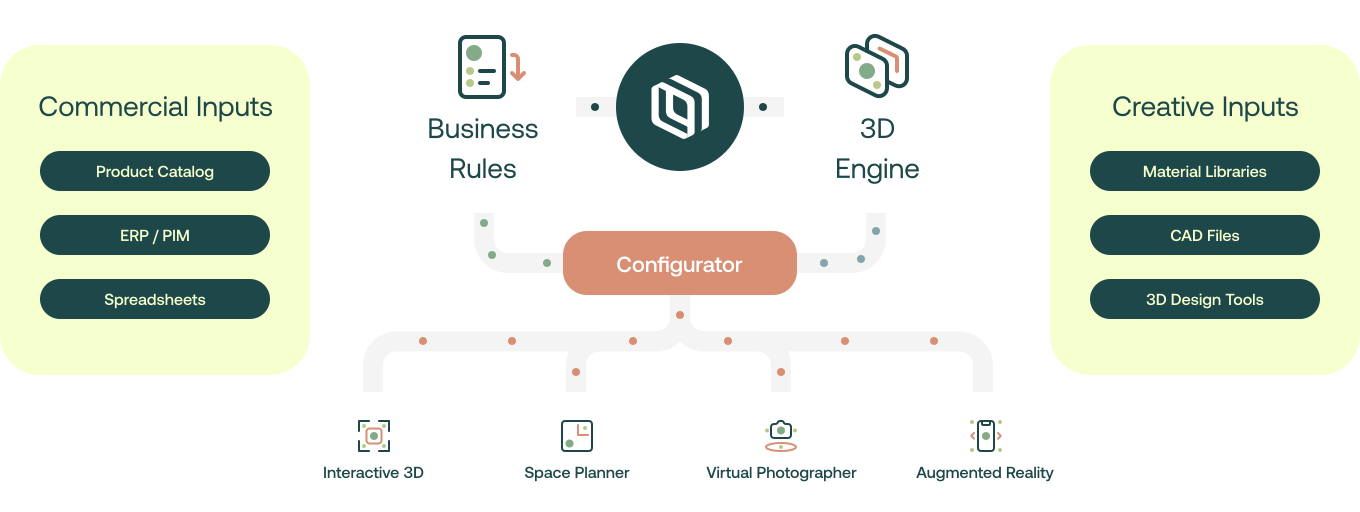
Source: Threekit
Threekit’s Strengths & AI Capabilities
In recent years, Threekit has shifted its focus toward lead intelligence and guided configuration, positioning the platform less as a traditional PDP enhancement tool and more like a digital sales assistant for complex catalogs.
AI Product Discovery & Guided Selling
Think of this as a smart consultant. It uses Natural Language Processing (NLP) to let users search a catalog by describing their needs in plain language, like "I need a fire-rated door for a school entrance."
The system filters out invalid options and narrows the catalog down to technically correct products before showing visuals.
Perfect for massive catalogs where users don’t know exact SKUs or technical requirements.
Deep Logic & Rules Engine
Threekit is built for parametric configuration. If you sell industrial products where certain components can only be combined under specific conditions, Threekit’s logic engine handles this perfectly.
Salesforce & CPQ Integrations
For B2B companies running Salesforce CPQ (Configure, Price, Quote), Threekit offers deep native integrations. This makes it a popular choice for wholesale and enterprise sales teams.
Threekit Downsides: What Users Are Saying
Threekit’s power can create enterprise‑level friction. Based on user feedback, teams often mention challenges related to setup time, ongoing updates, cost, and usability.
Here are the most common points users highlight:
1. Complex Setup & Slow Maintenance
Because Threekit is built around deep configuration logic, initial implementation is often heavy. Setting up logic rules for large catalogs can take months, but the bigger challenge is keeping everything up to date. For brands with fast-changing assortments, adding new SKUs or updating collections often requires technical support.
In fast-paced e-commerce, this creates a real risk: new collections don’t always launch when planned. When speed matters, waiting weeks for updates can mean missing the season entirely.
What users say:


Source: g2
2. High Total Cost of Ownership
Threekit follows an enterprise pricing model. When you add platform fees, implementation, and ongoing maintenance, costs rise quickly. For many brands, the first-year budget reaches six figures.
What users say:


Source: g2

Source: Gartner
3. Technical Barriers
The admin panel is mainly built for technical users. Even simple updates, such as changing a material, texture, or product variation, often require developer involvement or support tickets. This can slow down marketing and merchandising teams, especially for smaller brands.
What users say:


Source: g2
4. Performance & Integration Issues
Complex 3D models can impact page load speed. Users also report that some integrations, including Shopify, are not always updated in sync, which creates extra manual work.
What users say:

Source: Google reviews


Source: g2
5. Reliance on Third-Party Agencies
Threekit often depends on external partners for implementation (e.g. 3D modeling or custom integrations). This can lead to slower communication, unclear ownership, and longer resolution times when issues arise.
What users say:


Source: g2
Zolak: Everything Modern E-commerce Needs
Zolak is a comprehensive 3D product visualization platform built for modern e-commerce of all sizes. It proves that you don’t need a six-figure budget or a year-long rollout to create engaging product experiences online.
At its core, Zolak uses a single 3D asset foundation. Each product model is created once and then reused across every visual touchpoint on your store. It keeps setup simple, performance fast, and ongoing management easy.
With Zolak, you get:
- Photorealistic 3D visuals for product pages and marketing.
- Interactive 3D configurators and viewers with real-time customization and AR.
- Immersive virtual showrooms that display complete product sets in realistic scenes.
- AI-powered room visualization to place multiple products into a shopper’s real space.

Why Zolak Is the Right Fit for Most Brands
While Threekit is designed to manage complex engineering rules, Zolak solves the specific challenges of modern e-commerce: speed, visual fidelity, and conversion.
1. Setup Speed: 2–6 Weeks
Threekit implementations often take months and require system integrators, long onboarding, and heavy coordination before going live.
Zolak is built for the pace of modern e-commerce platforms, including Shopify, Magento, BigCommerce, and other leading solutions.
- Already have 3D assets? Upload your existing 3D models to the CMS, add materials and product configuration rules.
- Starting from scratch? Zolak’s 3D team can create accurate digital twins for you (see the implementation guide & pricing).
- Seamless integration: Once the digital catalogue is set up, you just copy a ready-to-use script and paste it where you want the module (3D Viewer, Configurator, or Showroom) to appear.
2. User-Friendly CMS
With Threekit, even small updates often require developer involvement or support tickets.
Zolak puts control where it belongs: in your dedicated team hands. The intuitive, self-managed CMS lets you:
- Add new fabrics or color collections in minutes.
- Create new product variations in a few clicks.
- Build seasonal showroom scenes without external support.
.webp?width=1920&height=1080&name=83%20(2).webp)
3. Generating Marketing Visuals at Scale
Threekit’s “Virtual Photographer” relies on traditional rendering workflows, which often come with a steep learning curve and longer production cycles.
Zolak Studio is a self-service virtual photo studio that generates photorealistic silo and lifestyle images from 3D models or 2D product photos.
-
Easy to use: An intuitive interface designed for everyday use, with no technical expertise required.
-
Cost savings: Up to 90% cheaper than traditional photography.
-
Fast output: Generate & distribute visuals in minutes.
4. Affordable, Transparent Pricing
Threekit follows a classic enterprise pricing model with high upfront fees and long-term contracts.
Zolak uses a modular, pay-for-what-you-use approach:
-
Platform Fee (CMS): Starts from $25/mo (includes 10 models & 50 materials).
-
Interactive Modules: 3D Configurator from $25/mo (up to 5,000 sessions), Virtual Showroom from $125/month.
-
Studio (virtual photography): Credit-based (e.g., $120 for 1,000 credits).
This low barrier to entry means you can start seeing a lift in conversion rates (up to 30%) within months instead of quarters.
5. All-in-One Support
Unlike Threekit, which often sends customers to third-party partners for implementation and support, Zolak handles everything in-house.
No need to coordinate between agencies, freelancers, or multiple vendors. Your dedicated Zolak team manages 3D modeling, onboarding, integrations, custom features, and ongoing support.
This means:
-
Instant fixes: No waiting weeks for external partners to respond.
-
One point of contact: One team owns your entire setup from start to scale.
-
Seamless updates: New features and upgrades roll out without disrupting your store.
-
Prioritized enhancements: Roadmap aligned with your growth, not a third party’s schedule.
-
Less operational overhead: Focus on selling and scaling, not managing vendors.
Guided Selling vs. Visual Selling: Two Different Paths to Conversion
Both platforms drive sales using AI, but they do so by activating very different buyer motivations. The difference comes down to how people make decisions.
At a high level:
-
Threekit helps customers choose the correct product using rules and specifications.
-
Zolak рelps buyers feel confident by showing products in context.
Threekit: Guided Selling
Threekit works like a digital sales engineer. Its AI guides users through complex catalogs with structured questions, applying rules and eliminating invalid options until the correct SKU is found.
Example scenario:
- A customer types: “I need a rugged laptop compliant with IP68 standards for a construction site.”
- Threekit applies logic filters and delivers the exact configuration that meets all technical requirements.
Best for:
Highly complex, spec-driven B2B products.
Zolak: Visual Accuracy & Contextual Selling
Zolak approaches sales by combining precise product configuration with real-world context.
Customers configure the product, place it in a real setting, and add complementary items to build a complete interior.
This level of personalization directly addresses the imagination gap, one of the main reasons shoppers hesitate or abandon carts.
How it works:
-
Pre-designed showroom templates. Create curated scenes to showcase recommended or best-selling collections in realistic, high-fidelity environments.
-
Bundle selling. Customers see how a sofa, rug, and lamp work together in a single scene. This naturally encourages multi-item purchases and can increase AOV (average order value) by up to 65%.
-
AI-powered room visualization. Unlike the Threekit Space Planner, which works like a manual CAD tool where users must draw walls and drag boxes, Zolak AI Showroom scans a customer’s real room photo, removes existing furniture, and places your products with correct scale, lighting, and shadows.
Example scenario:
- A customer thinks, "Will this armchair fit in my small living room, and does the velvet match my curtains?"
- Zolak places the armchair inside the customer’s actual space, eliminating guesswork and reducing purchase anxiety.
Best for:
- Furniture, home décor, fashion, and lifestyle brands.
- Products driven by emotion, aesthetics, and personal taste.
- E-commerce teams focused on conversion rate and AOV.
Threekit vs. Zolak: A Side-by-Side Comparison
Here’s a head-to-head look at how Threekit and Zolak differ, so you can quickly see which platform fits your business needs.
| Feature | Threekit | Zolak |
| Core Philosophy | Logic-first enterprise platform built for complex B2B products and rules-driven sales. | Visual-first platform designed for modern e-commerce (B2B, B2C, DTC brands), combining accuracy with immersive, in-context experiences. |
| AI Approach | Conversational. NLP guides users through rules and SKUs. | Visual (Computer Vision). Scene reconstruction, room scanning, object removal, automatic scaling, camera optimization, and lighting tuning. |
| Room Visualization | Manual CAD-style planner. | Photorealistic virtual showroom with multi-product placement and in-context customization. |
| Sales Strategy | Guided selling ensures technically correct configurations. | Visual accuracy & contextual selling boosts AOV with shoppable bundles and realistic room presets. |
| Implementation | Heavy, 3–8 months, often requires system integrators. | Fast, 2–6 weeks, low-code/no-code integration via script. |
| Content Creation | Virtual Photographer. Traditional ray-tracing render pipelines. High quality, but slow and production-heavy. |
Zolak Studio. AI-powered, self-serve generation of high quality lifestyle scenes and silo visuals in minutes. |
| Ongoing Management | Developer-dependent. Complex admin panel designed for engineers. | Self-managed CMS. Non-technical users can update models, materials, and scenes instantly. |
| Cost | Enterprise pricing with high upfront and ongoing fees. | Modular, transparent pricing based on usage. |
| Best Fit | Large B2B enterprises with complex configuration and CPQ workflows. | E-commerce brands focused on conversion, engagement, visual clarity, and faster time-to-market. |
Which One is Right for You?
Choose Threekit if:
- You are a B2B manufacturer with highly technical, complex products (e.g., medical devices, industrial parts).
- You have an enterprise budget and a dedicated team to manage long, technical implementations.
- You need guided selling to act like a digital sales rep, validating configurations with rules and logic.
Choose Zolak if:
- You are a brand or retailer (Furniture, Home Décor, Lifestyle) focused on e-commerce metrics like conversion rate, AOV, and time on site.
- You want to quickly generate high-quality marketing assets for digital campaigns and product content.
- You need to launch in weeks with full control over your catalog.
- You’re looking for a transparent, affordable solution that delivers fast and measurable ROI.
Conclusion
Not every brand needs the Ferrari of 3D configurators. For the majority of consumer-focused brands, the goal is to choose a tool that actually helps your customers say “yes.”
Threekit excels when the sale is a process. If your product requires engineering rules, custom quoting, or deep ERP/CPQ integration, Threekit is designed for that complexity. It’s ideal for procurement teams, dealers, or architects who need precise specifications and formal approvals.
Zolak stands out by combining configuration accuracy with immersive, in-context visualization. Customers can personalize every detail, place products in realistic rooms, and build complete scenes with complementary items.
With fast implementation, an intuitive CMS, AI‑powered content creation, and full in‑house support, Zolak delivers a frictionless way to drive conversions, reduce hesitation, and increase AOV.
Ready to see Zolak in action?
Book a personalized demo today and experience how visual commerce can help you win in 2026.
.jpg)