-1.svg)
E-commerce is more competitive than ever. Global online sales are expected to hit $8.1 trillion by 2026, and marketplaces, direct-to-consumer brands, and traditional retailers are all fighting for customer attention. Competing on price or vague claims of uniqueness no longer works. The sustainable edge now comes from experience.
3D product visualization and augmented reality (AR) transform online shopping into that experience. Virtual try-ons, room placement, and real-time configurators build confidence, spark emotion, and convert interest into purchases. Brands using 3D/AR see conversion lifts of up to 94%.
This guide explores why differentiation matters, how 3D and AR transform shopping, their measurable business impact, and a practical roadmap for getting started.
Why Differentiation Matters Today
In 2025, consumers are overwhelmed with options and increasingly short on time. Market saturation, rising expectations, and high return costs make it harder for brands to stand out.
Saturated Digital Channels
Shopify reports a 36% year-over-year (YoY) increase in new sellers while orders per seller have fallen 8%. Amazon alone lists 9.7M+ sellers (≈2M active). Shoppers wade through endless similar listings and leave unless they find something truly different.
Short Attention Spans
The average attention span has fallen from 12 to 8 seconds, and younger shoppers move even faster. If a product page doesn’t deliver instant clarity and engagement, they swipe away. 83% of Gen Z online shoppers expect e-commerce to feel interactive and rewarding from the first tap.
Rising Expectations
Photos and videos are no longer enough. Consumers want to see the real-world context: a sofa in their living room, lipstick on their skin, or a speaker on their shelf. Without immersive experiences, hesitation grows, and cart abandonment averages 70%.
High Cost of Returns
Online return rates hover around 30%, more than triple in-store levels. They cost retailers an average 21% of order value, factoring in restocking, shipping, and lost margin. Reducing uncertainty before purchase is essential for improving profitability and operational efficiency.
3D and AR: A New Language for Digital Commerce
To avoid becoming “just another option,” brands need richer, interactive experiences that capture attention, build confidence, and leave a lasting impression.
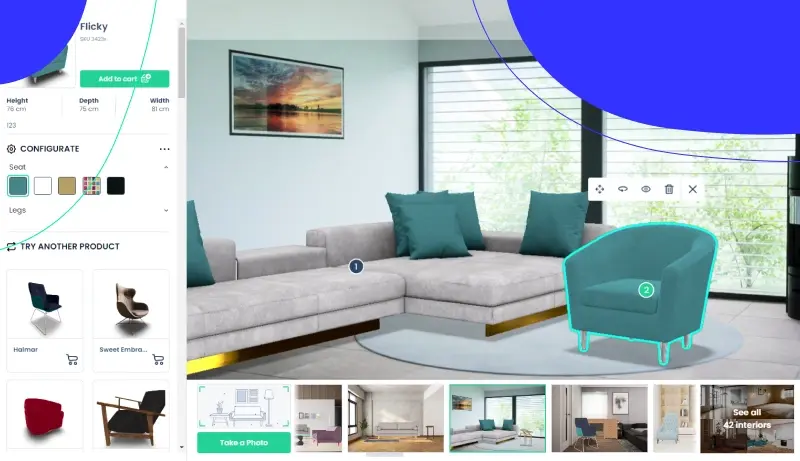
3D and AR technologies make this possible. Shoppers can interact with products in ways traditional photos never could, inspecting every angle, trying options, or placing items in their real-world environment.
Key 3D & AR Tools
3D Product Configurator
- What it is: A web‑based 3D viewer that lets customers change colors, materials, and features, spin and rotate a product, and preview options in real time.
- How it helps: Increases confidence and conversion by enabling instant visualization of endless variations and highlighting product versatility.
AR “View in My Space”
- What it is: True‑to‑scale placement of a product into the shopper’s real environment via a phone/tablet camera, or AR glasses.
- How it helps: Validates size, fit, and style in context, reducing returns and creating a “try-before-you-buy” experience.

3D & AR Virtual Showroom
- What it is: An immersive space where customers explore products in lifelike settings, customize and explore them in 360, interact with features, or place in their own environment.
- How it helps: Delivers brand storytelling, drives product discovery, and supports cross-sells and upsells.
 Source: Toyota
AR Virtual Try-On
- What it is: Live overlay of products (glasses, jewelry, makeup, apparel) onto a user’s face or body using the device camera.
- How it helps: Replaces guesswork for fit and appearance, encourages experimentation, and increases confidence for beauty and fashion purchases.
 Source: Trillion
7 Ways 3D & AR Differentiate Your Brand
The adoption of 3D and AR directly impacts key business metrics: longer engagement, fewer returns, higher average order value (AOV), and stronger brand perception.
1. Immersive Engagement
Interactive 3D/AR transforms passive browsing into hands-on exploration. Shoppers spin, customize, or place products in their space — driving up to 70% longer session times and 20-30% lower bounce rates.
2. Improved Product Visualization & Confidence
Customers can inspect products from every angle or see them in their own environment, reducing uncertainty. 66% of shoppers report higher purchase confidence after engaging with 3D/AR.
3. Fewer Returns & Higher Satisfaction
Accurate, in-context previews help resolve concerns around size, fit, and style before purchase. Brands have seen up to 40% fewer returns, while 65% of shoppers say AR makes the shopping experience easier.
4. Faster Content Production
A single high-quality 3D model can be used across product pages, social media, and email campaigns, saving up to 90% on content creation and speeding up time-to-market for new SKUs.
5. Creating Emotional & Memorable Brand Experiences
AR-enabled packaging can showcase a product’s backstory or craftsmanship, building deeper emotional connections and brand loyalty. Plus, 3D/AR drives gamification — with interactive challenges, games, and filters that encourage user-generated content (UGC).
6. Leveraging Data for Personalization
Every interaction provides valuable data on preferences, engagement, and drop-offs. Brands can use this insights to fine-tune product recommendations (“you may also like…”), optimize marketing strategies, and even inform product design.
7. Higher AOV & Upselling Potential
3D/AR visualization of product variations and complementary items encourages customers to consider premium options, add-ons, and cross-sells. This can increase AOV by up to 60%, driving higher revenue per transaction.
Real-World Case Studies & Measurable Results
By bridging the gap between imagination and reality, 3D/AR help brands stand out, reduce hesitation, and drive meaningful business results. Here’s how early adopters have translated immersive experiences into measurable impact.
IKEA Place
- Challenge: Online shoppers often struggle to judge if furniture fits their space or matches their décor, leading to hesitation and costly returns.
- Solution: IKEA Place uses AR to let customers place true-to-scale 3D models of furniture in their own rooms via smartphone camera. By visualizing exact dimensions, materials, and styles in context, shoppers gained confidence before purchase.
- Results: +189% conversions, -20% returns, 3.5x longer sessions, +35% AOV.
 Learn More
IKEA Place showcases how augmented reality can transform the shopping experience by letting users visualize furniture in their real space. To see how Zolak compares to IKEA’s approach to AR technology in room visualization — Zolak vs IKEA Kreativ, check out our detailed comparison.
Warby Parker Virtual Try-On
- Challenge: Buying eyewear online is challenging without an in-store try-on. Shipping home try-on kits increases customer acquisition cost (CAC), slows purchase decisions, and wrong-frame choices drive returns.
- Solution: AR try-on in app and web store replicates the mirror experience at home, helping customers pick frames confidently.
- Results: +85% conversions, -41% kit requests, -22% returns.
Nike Fit
- Challenge: Sneaker brands constantly battle cart abandonment due to size uncertainty.
- Solution: Nike recognized that better sizing = stronger loyalty in an ultra-competitive footwear market. 3D foot scanning via smartphone measures 13 points to recommend precise sizes across models.
- Results: -20% returns, +15% online sales, improved long-term satisfaction.
Sephora Virtual Artist
- Challenge: Flat product images and swatches make it hard for beauty shoppers to experiment with colors online.
- Solution: AR app lets customers instantly try thousands of makeup shades on their own faces, recreating the in-store try-on digitally and removing the guesswork.
- Results: +112% conversions, -28% returns, +45% time in app.
Note: KPIs are approximate and drawn from publicly available data.
Tactical Guide to Implement 3D & AR
Immersive technology can only create impact when it addresses real buyer pain points. The challenge for most brands is how to roll it out effectively without burning through resources or losing customer trust.
The key to success lies in starting lean, focusing on quality, and scaling with data-driven insights. Here’s your roadmap to a successful 3D/AR launch:
1. Start with a Pilot
Focus on products where fit, size, or aesthetics matter most. Begin with a small-scale pilot, gather feedback, and iterate before expanding to your full catalog.
2. Prioritize Quality and Performance
Invest in high-quality, photorealistic 3D models and fast-loading AR experiences. Ensure that the assets are optimized for seamless mobile performance.
3. Integrate Across Channels
3D/AR shouldn’t live only on your product page. Extend experiences to social media campaigns, in-store displays, and product packaging to create a consistent, immersive brand presence.
4. Measure and Iterate
Track key performance indicators such as conversion rates, engagement time, and reduced return rates. Use these insights to continuously improve the user experience and guide the scaling process.
5. Scale Gradually
Avoid rushing into a full-scale rollout. Start with proof of ROI and gradually expand 3D/AR experiences to other categories based on what works best for your audience.
Quick Wins to Deploy This Quarter
- Add an “AR” badge and deep‑link from product tiles for top sellers.
- Create a single hero “View in my room” AR for a flagship SKU and promote it via paid social.
- Replace 2-3 hero photos with interactive 3D spins on best‑selling pages.
- Add a QR code on packaging and order confirmations that launches AR placement for add‑ons.
Pitfalls to Avoid
- Gimmicks that don’t solve real buyer problems.
- Low-quality assets that erode trust.
- Heavy files that freeze mobile sessions.
- Overcomplicated flows — if it takes more than 3 taps to reach AR, users drop off.
- No analytics — if you don’t measure AR usage, you can’t prove ROI.
This approach lets you maximize your AR investment without the risks of unnecessary complexity or wasted resources.
Conclusion: Experience Wins in Crowded Markets
In today’s crowded e-commerce landscape, experience is the ultimate differentiator. 3D and AR turn browsing into interactive journeys that emotionally connect shoppers with your brand. Early adopters see tangible results: longer engagement, fewer returns, and stronger loyalty.
Zolak Makes It Effortless
Bring 3D and AR to life without usual headaches. Zolak combines photorealistic 3D configurators and AR experiences in one seamless platform:
- Zolak 3D Configurator: Showcase products from every angle and in every variation. Customers can instantly swap colors, materials, and options to see their ideal combination — without leaving the page.
- Zolak AR: Go beyond simple placement. Let customers customize items in the scene, stack multiple products, and see exactly how everything fits in their space.

Deliver immersive experiences across your website, social channels, and in-store displays — starting at just $140/month. No specialist team, no months of setup. Launch fast, scale confidently, and see measurable results: 3x-5x longer engagement, up to 45% higher sales, and 57% conversion boost.
Book a demo today to see how Zolak helps create “wow” moments and turn product pages into experiences that sell.
%20(1).webp)