

-1.svg)
You’ve invested in a modern online store with stunning product photos and polished descriptions. Yet conversions remain below target, and returns continue to cut into your margins. Often, the problem isn’t the product or pricing — it’s the customer uncertainty.
Because online shoppers can’t touch, feel, or try items before buying, many hesitate to complete a purchase — and when the product fails to meet expectations, they return it.
3D product experiences close that gap. It lets customers rotate, zoom, customize, and place products in their own space — turning hesitation into confidence, and confidence into conversions.
This article explores how 3D shopping works, where it creates the most impact, and how to choose the right solution for your business.
Why Online Shopping Struggles with Conversions and Returns
E-commerce has streamlined shopping but still cannot replicate the confidence of in-store buying. Photos, specifications, and reviews fail to convey realistic texture, scale, and context. For retailers, this uncertainty comes at a high cost:
- 70% of carts are abandoned, with fit, size, or quality concerns among the top reasons.
- Returns average 20%, reaching 30-40% in categories like apparel, footwear, and furniture.
- Each return costs up to 21% of the item’s price in logistics and handling, plus inventory write-offs and environmental impact.
The bottom line: the same uncertainty that limits conversions before checkout also drives high return rates afterward — undermining both revenue and customer trust.
What Is an Interactive 3D Product Experience?
A 3D product showcase lets shoppers explore and customize a digital 3D version of a product directly on your site. Unlike static photos, it enables real-time interaction, helping buyers understand scale, fit, and detail before purchase.
Modern platforms integrate 3D experiences AI, AR, and VR to enhance product understanding by enabling shoppers to preview items in their own space or virtually try them on — no app required.
Key features:
- 360° and full 3D interactive viewing: Rotate and examine products from every angle.
- Real-time customization: Change colors, materials, or finishes instantly.
- Zoom for detail: Inspect stitching, textures, or fine design elements.
- AR/Virtual Try-On: Preview an item in a room or try them on virtually.
The result: Customers move from imagining to experiencing, making more confident purchase decisions.
 Learn More
Does 3D Product Experience Actually Boost Conversions and Reduce Returns?
Short answer: Yes. Industry data shows that, when implemented effectively, virtual product exploration increases conversion rates by 10-30% and reduces return rates by 20-40%.
Why it works: Most buying friction comes from uncertainty. If a shopper misjudges size, color, or proportion, they either don’t buy (lost sale) or return the product (lost margin). Immersive, accurate visualization eliminates that gap.
How It Boosts Conversions
- Enhanced product understanding: Interactive 3D views replicate real-life experiences.
- More time-on-page: Shoppers explore products ~2× longer.
- Emotional connection: Products feel “real,” triggering buying intent.
- Personalization at scale: Shoppers can design and customize items that match their liking and needs.
- Faster decisions: Unified 3D views enable direct comparison of variations, reducing uncertainty and accelerating checkout.
How It Reduces Returns
- Expectation alignment: Shoppers accurately assess size, scale, and details.
- Real-world context: AR lets shoppers preview furniture in a room or apparel/jewelry on themselves.
- Fewer surprises: No more “looks different online” surprises.
- Reduced post-purchase regret: 3D product experiences encourage thoughtful, confident purchases.

Where Virtual Product Exploration Creates the Most Value
Interactive 3D delivers the highest ROI for products categories where size, fit, or customization directly influence the buying decision.
High-Impact Categories & Benchmarks
| Category | Return Rate Reduction | Conversion Lift | Why It Works |
| Furniture & Home Décor | 30–40% | 15–25% | Shows accurate dimensions, colors, finishes. Enables room planning & bundling, and AR placement. |
| Jewelry & Accessories | 20–30% | 10–20% | Reveals precise details like gemstone cuts, metal texture, and clasps. |
| Footwear & Apparel | 20–25% | 12–18% | Virtual try-ons reduce uncertainty about size and style. |
| Electronics & Gadgets | 15–20% | 10–15% | Interactive exploration lets shoppers inspect ports, screens, and design details in full. |
Note: These benchmarks are based on vendor and industry data and can vary by sector and implementation quality.
Real-World Results
- Shopify merchants see +94% average conversion lift with 3D/AR product views.
- IKEA boosted conversions by 14% and cut returns by 23% with IKEA Place, their AR furniture placement app.
- Nike achieved a 15% jump in online sales and reduced size-related returns by 20% with Nike Fit — a 3D foot scanning app.
- Ferguson Home (formerly Build.com), online seller of home improvement products, reduced return rates by 22% with AR visualization.
- DFS, the UK’s top sofa retailer, achieved a 112% conversion lift by integrating 3D and AR across their customer journey.
Key Factors for Effectiveness
- Model quality: Photorealistic, true-to-scale 3D models build trust. Poor-quality renders can increase uncertainty and hurt conversions.
- Placement & reach: Use render videos or short 3D animations in ads and social media to attract attention, 3D viewers on category pages to engage top-of-funnel shoppers, and 3D configurators, virtual showrooms, “View in AR”/“Try-On” on product pages to convert high-intent buyers.
- Performance & mobile optimization: Smooth, responsive tools with fast load times are critical — 70-75% of e-commerce traffic comes from mobile.
- Audience fit: Younger, digital-native shoppers adopt faster. A mobile-first, intuitive interface ensures accessibility for all audiences.
Choosing the Right Platform
To maximize ROI, choose a platform aligned with your goals, product type, and workflow.
1. Define Your Goals
- Boost conversions: Prioritize photorealistic 3D models. Lifelike experiences increase engagement and buying intent.
- Reduce returns: Features supporting accurate scale, textures, and AR placement enable shoppers to evaluate products confidently before purchase.
- Increase AOV/cross-sell: Virtual showrooms and multi-item bundling tools encourage complementary purchases.
2. Match Features to Product Type
- Furniture & home décor: 3D viewers, true-to-scale AR, room scan, virtual showrooms.
- Apparel & footwear: Virtual try-on, fit engines, size recommendations, fabric detail zoom.
- Electronics & gadgets: 360° views, high-res zoom, interactive hotspots for ports/features.
3. Focus on Ease of Use
- Customer experience: Fast loads, mobile-first UI, WebAR, intuitive controls.
- Internal ops: One-click publishing, Shopify/Magento/WooCommerce plugins, or APIs.
4. Balance Сost and ROI (SaaS vs Сustom)
- SaaS: Fast to launch, flexible pricing (e.g., Zolak Virtual Showroom with a built-in 3D Configurator starts at $125/month for the starter pack), and built-in integrations — ideal for most retailers.
- Custom builds: Higher flexibility and deeper integrations. Costs scale from tens of thousands to enterprise budgets >$500k.
5. Streamline Visual Content Workflow
Prioritize all-in-one 3D platforms that automatically turn your 3D models into marketing-ready assets — white-background product images, lifestyle renders, 360° spins, and short videos. This speeds up content production, keeps visuals consistent across all channels, and can cut traditional photography costs by up to 90%.
6. Check Support and Scalability
Look for centralized CMS for managing 3D assets, bulk uploads, and reliable vendor support with clear SLAs and data compliance.
Zolak: Best-in-Class Visual Commerce Platform
Zolak solves the two biggest challenges in e-commerce: low conversions and high returns. It combines a 3D configurator & AR, an AI-powered showroom, and Studio + AI visual assistant in a single platform.
Key features:
- 3D configurator: Real-time customization with 360° viewing and full 3D zoom.
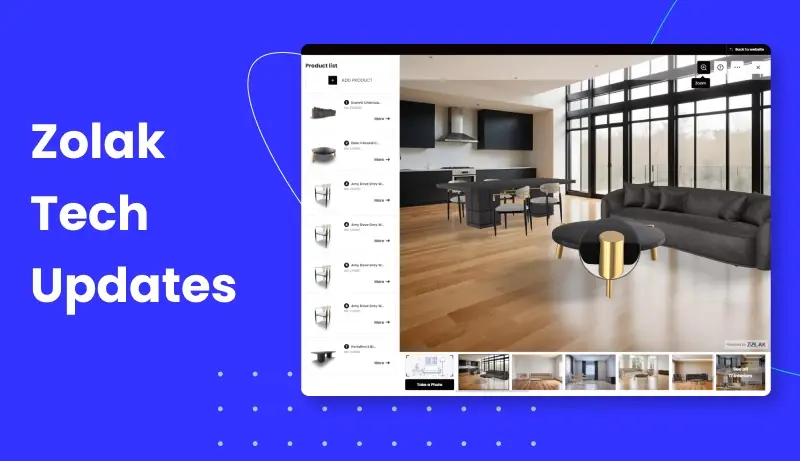
- Virtual showrooms: Let customers place and arrange multiple items in AI-scanned or pre-built rooms.
- AR preview: Place true-to-scale products into real environments directly from the browser.
- Automated visual content: Generate lifestyle renders, 360° spins, and videos from a single 3D model or 2D image.
- Built-in CMS: Host, manage, distribute models, textures, and SKUs at scale.
- E-commerce integration: Direct compatibility with Shopify, Magento, WooCommerce, and other major platforms ensures fast setup and synchronized product data.
Proven results: Zolak clients report 2× higher conversions, 32-56% lower bounce rates, and up to 40% fewer returns.
Conclusion
Uncertainty is the #1 driver of lost sales and costly returns in e-commerce. Shoppers want confidence that what they buy online will match real life.
Interactive 3D product view recreates the in-store experience online, giving customers the visual and spatial context they need to buy with confidence. When applied to the right products and audiences, it can boost conversions by 10-30% and cut returns by 20-40%.
If your return rate is above 15% or you sell products where fit, scale, or customization drive buying decisions, it’s time to make 3D visualization services part of your storefront.
Ready to transform hesitation into confidence? Book a Zolak demo today and elevate your e-commerce results with immersive 3D experiences.
.webp)
